
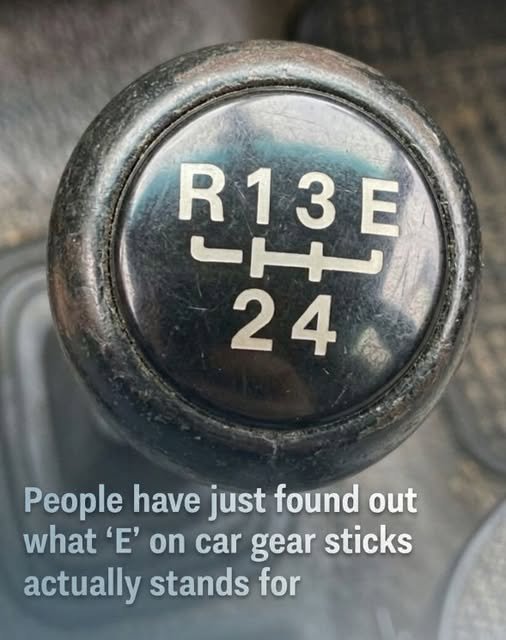
If you have ever looked at the gear selector of an older car and noticed a mysterious “E”, you may have wondered what it means.
Most drivers immediately recognize P for Park, R for Reverse, N for Neutral, and D for Drive. Some older automatic transmissions also feature L, 2, or S. But an “E” can look completely unfamiliar, especially to drivers who grew up with modern vehicles.
So, does the “E” stand for Electric? Emergency? Something else entirely?
On many older vehicles, the answer is much simpler: E stood for Economy.
This forgotten transmission setting was designed to help improve fuel efficiency by changing the way an automatic transmission shifted through its gears. It was an early mechanical approach to something that modern vehicles now accomplish electronically with features such as Eco Mode.
What Does “E” Actually Stand For?
The “E” on an older automatic transmission generally meant Economy.
When Economy mode was selected, the transmission was designed to shift into higher gears at lower engine speeds. In other words, the engine would not rev as high before the transmission shifted.
The goal was straightforward: reduce engine speed and fuel consumption during normal driving.
The trade-off was performance. Because the transmission prioritized fuel economy, acceleration could feel slower or less responsive. The vehicle might seem somewhat sluggish compared with the same car operating in its normal Drive setting.
A useful way to think about it is this:
Old “E” mode was an early mechanical predecessor to the Eco modes found in many modern cars.
When Did the “E” Gear Exist?
The Economy setting appeared primarily on certain American and Japanese vehicles from the late 1970s through the mid-1980s.
It was never a universal feature, which is one reason many drivers have never encountered it.
Some vehicles from manufacturers such as General Motors, Ford, Chrysler, and Honda experimented with fuel-saving transmission features or Economy settings. Depending on the vehicle, the function could appear directly on the gear selector or as a separate Economy/Econ button.
Why Did Automakers Introduce It?
The timing makes sense when you consider what was happening in the automotive industry.
The 1970s oil crises increased concerns about fuel consumption and encouraged automakers to develop more efficient vehicles and technologies.
Fuel economy became an increasingly important selling point. Manufacturers experimented with different solutions, including transmission designs and driving modes intended to reduce unnecessary engine speed.
The “E” setting was one of those solutions.
However, it did not become a universal standard. In some vehicles, it was an optional feature or a relatively short-lived experiment.
How Did “E” Economy Mode Work?
To understand the difference, it helps to compare D and E.
Standard “D” — Drive
In normal Drive, an automatic transmission selects gears according to programmed or mechanically controlled shift points.
The transmission balances several factors, including acceleration, road speed, engine speed, and driving conditions.
“E” — Economy
Economy mode placed greater emphasis on fuel efficiency.
The transmission could shift into a higher gear sooner, allowing the engine to operate at a lower RPM.
At cruising speeds, this could reduce engine workload and fuel consumption.
The downside was that the car could feel less responsive when the driver pressed the accelerator.
The Connection With Overdrive
In many older vehicles, Economy mode was closely related to overdrive.
Overdrive refers to a higher transmission gear that allows the engine to turn at a lower RPM while the vehicle maintains highway speed. Lower engine speed can reduce fuel consumption and engine noise during cruising.
On some vehicles, selecting Economy mode could encourage earlier or more frequent use of the higher gear.
However, the exact operation depended on the vehicle and transmission design. Not every “E” system worked in precisely the same way.
Some Cars Used an “Econ” Button
Interestingly, the “E” did not always appear on the gear selector itself.
Some vehicles used a separate Econ or Economy button on the dashboard. Pressing the button could change the transmission’s shift behavior without requiring the driver to move the gear selector.
That variation is another reason the feature is relatively unfamiliar today.
Why Did the “E” Setting Disappear?
For Complete Cooking STEPS Please Head On Over To Next Page Or Open button (>)
