
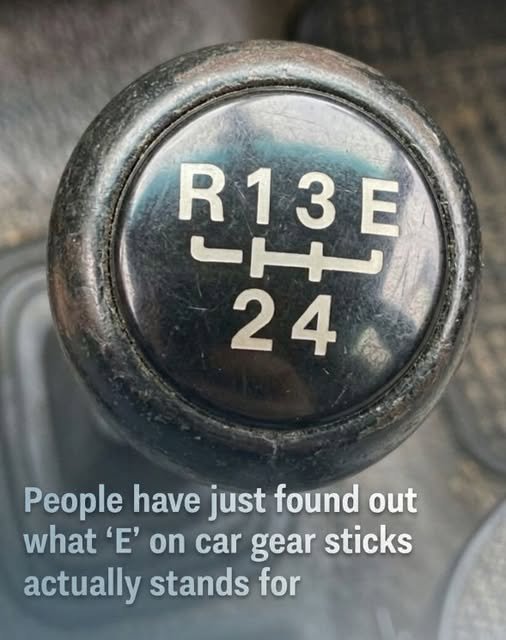
Why Did the “E” Setting Disappear?
The Economy gear selector did not remain popular for very long.
By the late 1980s and afterward, automotive technology was changing rapidly. Several developments made a dedicated mechanical Economy setting less necessary.
1. Electronic Transmission Controls
Older automatic transmissions relied heavily on mechanical and hydraulic systems.
As electronic controls became more sophisticated, manufacturers gained the ability to control transmission shift points much more precisely.
Instead of giving the driver a simple Economy position, computers could adjust transmission behavior according to driving conditions.
2. Overdrive Became More Common
Overdrive eventually became a standard feature on many automatic transmissions.
Once transmissions could automatically select higher gears during cruising, there was less reason to provide a separate Economy position simply to encourage lower engine RPM.
3. Drivers Didn’t Always Understand It
Another challenge was the unfamiliar letter itself.
Drivers were accustomed to P, R, N, and D. An “E” was not immediately obvious, and some motorists were unsure about when they were supposed to use it.
If a feature provided only modest fuel savings while making acceleration feel slower, it could be difficult to justify as a separate gear-selector position.
4. Economy Technology Moved Into Computer-Controlled Systems
The concept itself did not disappear.
Instead, it evolved.
Modern vehicles can use electronic controls to adjust throttle response, transmission shift points, air-conditioning operation, and other systems when the driver selects an Eco or Economy driving mode.
The old mechanical “E” eventually gave way to much more sophisticated electronic systems.
Why Are Drivers Discovering “E” Again?
If the feature disappeared decades ago, why are people suddenly asking about it?
One reason is the growing interest in older and classic cars.
Someone purchasing a 1980s vehicle today may open the door, look at the gear selector, and encounter an unfamiliar “E” for the first time.
Social media has also played a role.
Photos of unusual dashboards and forgotten automotive features regularly attract attention online. A simple question such as “What does this E mean?” can quickly turn into a discussion among thousands of car enthusiasts.
There is also a generational factor.
A person may inherit an older vehicle from a parent or grandparent and discover features that were once completely ordinary but have since disappeared from modern cars.
That makes old automobiles surprisingly interesting time capsules of automotive history.
Old “E” vs. Modern Eco Mode
Although the basic goal is similar, the technology is very different.
| Feature | Older “E” Economy Mode | Modern Eco Mode |
|---|---|---|
| Main purpose | Improve fuel economy | Improve overall efficiency |
| Technology | Mechanical/hydraulic transmission controls | Electronic/computer-controlled systems |
| Transmission | Adjusted shift behavior | Computer-controlled shift strategy |
| Throttle | Generally unchanged | May provide softer response |
| Other systems | Limited effect | May affect climate control and other vehicle systems |
| Location | Gear selector or dedicated button | Dashboard button or drive-mode selector |
| Modern use | Mostly obsolete | Common in many newer vehicles |
The biggest difference is complexity.
The old “E” setting was primarily focused on transmission behavior, while modern Eco modes can coordinate several vehicle systems at the same time.
Should You Use “E” If Your Car Has It?
If you own an older vehicle equipped with an Economy setting, the appropriate choice depends on the specific transmission and the driving conditions.
Economy mode was generally intended to make sense during steady-speed driving, particularly when aggressive acceleration was not necessary.
For example, it could be useful when maintaining a relatively consistent speed on level roads.
However, situations that require stronger acceleration or frequent gear changes may call for normal Drive instead.
Examples include:
- Steep hills
- Heavy loads or towing
- Situations requiring quick acceleration
- Frequent stop-and-go driving
- Conditions where the transmission repeatedly shifts between gears
The most important point is that different vehicles used different transmission designs. If you own a classic car with an unfamiliar “E” setting, the vehicle’s original owner’s manual is the best source for its specific operation.
What Does “E” Mean in Modern Cars?
The letter “E” can have different meanings depending on the vehicle.
Some modern electric and hybrid vehicles use terminology related to Eco or efficiency modes, while certain commercial vehicles may also have Economy settings designed to reduce fuel consumption.
However, that does not mean every modern “E” has the same function.
For an older gasoline-powered car from the 1980s, an “E” on the automatic gear selector is commonly associated with Economy.
Other Forgotten Gear Selector Letters
The mysterious “E” is not the only transmission marking that can confuse drivers.
L — Low
Low keeps the transmission in a lower gear range and can be useful in certain situations such as steep descents or when additional engine braking is needed.
2 — Second Gear
The “2” position on older automatic transmissions generally limits the transmission to lower gears, depending on the design.
S — Sport
Sport mode changes transmission behavior to prioritize more responsive acceleration and different shift points.
M — Manual
Manual mode allows the driver to select gears manually, often through the gear selector or steering-wheel-mounted paddles.
B — Braking
On some hybrids and electric vehicles, “B” increases regenerative or engine braking behavior, helping the vehicle slow while recovering energy in applicable systems.
These markings show just how much transmission technology has changed over the decades.
What About the “E” on Early Electric Cars?
There is one interesting historical twist.
On some very early electric vehicles, an “E” could indeed refer to Electric.
But that is a completely different context.
If you are looking at the gear selector of a typical 1980s gasoline-powered automobile, the “E” is generally associated with Economy, not Electric.
Frequently Asked Questions
Does “E” mean Eco or Economy?
In the context of the older transmission feature discussed here, “E” refers to Economy. “Eco” is simply a modern abbreviation commonly used for efficiency-related driving modes.
Is Economy mode the same as overdrive?
Not necessarily.
Some older systems used Economy settings that encouraged earlier use of higher gears or overdrive, but the exact operation depended on the transmission.
Can Economy mode damage the engine?
The source material describes Economy mode as a change in transmission shifting rather than a feature intended to harm the engine. However, the correct operating procedure depends on the particular vehicle.
Why don’t modern cars have an “E” gear?
Modern electronically controlled transmissions can automatically manage shift points, while dedicated Eco modes can adjust several vehicle systems without requiring a separate gear-selector position.
Will an old “E” mode save a lot of fuel?
The fuel savings were generally modest. Factors such as driving style, road conditions, vehicle condition, speed, and unnecessary idling can have a significant effect on fuel consumption.
The Forgotten “E” Is a Piece of Automotive History
The mysterious “E” on an old car’s gear selector is a fascinating reminder of how quickly automotive technology evolves.
What looks like a strange or unnecessary letter today once represented an important engineering idea: use the transmission more efficiently to reduce fuel consumption.
The feature emerged during an era when fuel economy was becoming increasingly important to drivers and automakers. As electronic transmission controls, overdrive systems, and modern Eco modes developed, the physical “E” gradually disappeared.
But the idea behind it never really went away.
Today, when you see an unfamiliar E on an older automatic gear selector, you have a much better idea of what it represents.
It is a small piece of automotive history—and a reminder that many of the “new” fuel-saving ideas in modern cars have roots that go back decades.
For Complete Cooking STEPS Please Head On Over To Next Page Or Open button (>)
