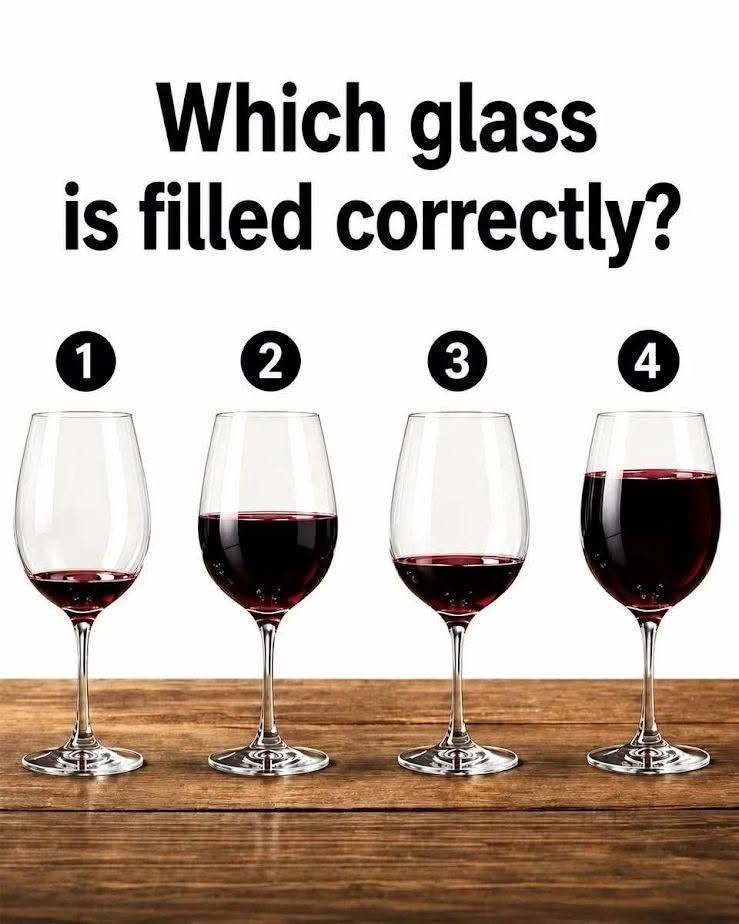
Why Are Wine Glasses Shaped That Way?
Before deciding which pour makes the most sense, consider the design of a traditional wine glass.
Unlike a typical drinking glass, a wine glass usually has a wide bowl that narrows toward the opening. This shape isn’t purely decorative.
The bowl provides room for the wine’s aromas to collect above the liquid. When you gently swirl the wine, more of its surface comes into contact with air, helping release volatile aromatic compounds.
That’s why wine enthusiasts often smell their wine before taking a sip.
You may notice aromas associated with fruit, flowers, herbs, spices, oak, or other characteristics depending on the wine.
Why You Shouldn’t Fill a Wine Glass to the Rim
Imagine trying to swirl Glass 4.
Because the wine reaches almost to the top, there’s very little room for movement. A vigorous swirl could easily send wine over the edge.
More importantly, the narrow opening of the glass is designed to concentrate aromas. Leaving some empty space gives those aromas somewhere to collect.
This is one reason a moderate pour is generally preferable to filling the entire glass.
Is the Exact Middle Always Correct?
Not necessarily.
It’s tempting to choose the glass that is filled exactly halfway because it looks visually balanced. However, wine glasses come in many different shapes and sizes, so there isn’t a universal rule saying wine should always reach the precise midpoint.
A standard serving of wine is often around 5 fluid ounces (148 mL) in the United States, but the visual appearance of that amount can vary significantly depending on the size and shape of the glass.
That’s why judging the correct pour solely by whether the wine reaches a particular line on the bowl can be misleading.
The Real Rule: Leave Room for the Wine
Rather than focusing on a specific height, think about what the wine needs.
A good everyday pour should generally:
- Provide a reasonable serving
- Leave enough room to swirl
- Allow aromas to collect inside the glass
- Reduce the chance of spilling
- Make the wine comfortable to drink
For many traditional wine glasses, this means avoiding a full glass and leaving substantial space above the wine.
The exact amount can vary depending on the occasion, the wine, and the glass being used.
Wine Tasting vs. Dinner Service
There is also an important difference between a formal wine tasting and an ordinary dinner.
At a tasting, very small pours are intentional. Guests may sample several wines without consuming a full serving of each one.
At dinner, however, the pour is usually more generous because the wine is being served as part of the meal.
So Glass 1 might make sense in a tasting environment but look unusually small at a dinner table.
What About Red and White Wine?
The ideal serving approach can also vary according to the type of wine.
Red wines are often served in larger-bowled glasses because their aromas benefit from additional space. White wines are commonly served in somewhat smaller glasses, although there are many exceptions.
Sparkling wines are another case entirely. Their glassware is designed to help preserve carbonation and showcase the wine’s aromas.
This means there isn’t one universal pouring level that works perfectly for every wine glass.
So, Which Glass Is Correct?
The answer isn’t simply about choosing the glass that looks halfway full.
Glass 4 is clearly too full for comfortable swirling, while Glass 1 is unusually small for a normal dinner serving. Between the middle options, the better choice depends on the size and shape of the glass and the amount being served.
The key principle is simple:
Don’t fill a wine glass to the rim. Leave enough room to swirl the wine and appreciate its aromas.
That’s the real secret behind a well-poured glass of wine.
So the next time you open a bottle for dinner, don’t worry about reaching a perfectly precise line on the glass. Instead, pour a moderate serving, leave plenty of space at the top, and give the wine room to breathe and release its aromas.
Sometimes, good wine etiquette isn’t about following one rigid rule—it’s about understanding why the glass was designed the way it was in the first place.
For Complete Cooking STEPS Please Head On Over To Next Page Or Open button (>)

What Is the Cabinet Above the Refrigerator Really For? Smart Storage Ideas Most People Overlook

We Found a Tiny Mystery in an Old Dresser — Then We Discovered What It Really Was

Don’t Be Fooled. They’re Selling You Meat